god is one data-manipulation engine written in Rust, callable from R and Python. You write your pipeline as a sentence, and the same sentence works in both. Its vocabulary is plain everyday English, and its shape comes from dplyr and tidyr, which are the tools that got this right.
Behind both is one promise:
Anyone who works with data should be able to read a pipeline aloud on day one, write one themselves on day two, and still have it after a year away.
That last clause is the hard one, and it is the reason this project exists.
A pipeline in god is a sequence of plain English verbs. You keep some rows, add a column, group and summarize, sort the result, and take the first ten. Each step takes a table and returns a table, so you can read a pipeline from top to bottom and stop anywhere.
Most of what anyone does to a table is ordinary work of exactly that kind, plus a join and a reshape. god is for that work, every day, in whichever of the two languages you happen to be in. It is not for the exotic case, and the chapter on what it refuses says so.
About the name
god is Grammar Of Data. Its sibling is gog, a grammar of graphics, and the two are named the same way for the same reason.
It is written lowercase, always, the way dplyr and pandas and npm are. Nobody writes DPLYR. No claim of any other kind is made by the letters, and none is intended. They are three initials that happened to spell a word, kept because the sibling naming is what makes the pair legible.
You will see it lowercase everywhere in this book, including at the start of a sentence.
You do not have to read this preface. Nothing in it is needed to write a pipeline. Install god, then go to your first pipeline, which begins the six everyday verbs. Come back here when you want to know why the grammar refuses what it refuses. If you would rather see all of it at once first, Appendix B is every word there is, on one page.
One sentence, three ways
The main way to write a pipeline in god is to say it. run takes the sentence, gives back the table, and is spelled exactly the same in R and in Python.
run('sales
       then keep where [region] is "West"
       then add [margin] as [revenue] - [cost]
       then summarize [margin] as total([margin]),
            [orders] as row_count() by [product]
       then sort [margin] descending
       then take 10')
product
margin
orders
Widget
165
3
Gadget
100
1
Doohickey
45
1
Sprocket
18
1
Read it aloud and it is a sentence. Keep the rows where the region is West. Add a margin column. For each product, total the margin and count the orders. Sort by margin, largest first. Take the top ten.
If you already write R, the same sentence has a pipe spelling.
None of the three is an illustration. All three ran when this page was built, and the table under each is the answer that came back.
A matter of taste. Which one you write is exactly that, and there is nothing you can reach with a pipe that you cannot say in a sentence. Both pipe spellings work by turning your code into the sentence above and handing that to the engine. Anything you can pipe, you can say.
Start with run. If this kind of work is new to you, it is the shortest thing to learn, it is identical in both languages, and it is the one spelling that still means something where there is no R or Python at all. The pipe flavors are here for readers who already think in dplyr or pandas, and who would rather not change hands to use this.
Two differences
The two pipe versions differ from each other in two things.
The pipe. R uses its native |>. Python uses >>.
The column. R writes a bare name, revenue. Python writes col.revenue.
No word in the vocabulary is spelled differently in the two languages. Every verb, every marker, every argument name is the same in both, and that is meant literally rather than approximately. One word broke it once, and it was renamed rather than excused.
What is left is not vocabulary but syntax, and all of it is Python’s own. This book states it here rather than letting you find it in an error message. Comparisons joined by & need parentheses, because & binds more tightly than ==. Negation is ~, because Python cannot redefine not. Asking whether a value is one of several is col.region.is_in([...]), and asking whether one is missing is col.cost.is_missing(), because Python’s in cannot be reached by an object at all.
A sentence with no host
A sentence is data. That is the one reason to prefer it that is not about taste. Some places have no language to bind into: a database cell, a configuration file, a pipeline that was stored or generated rather than typed. All of them can hold one of these, and it is the same grammar sitting there.
sales
  then keep where [region] is "West"
  then add [margin] as [revenue] - [cost]
  then summarize [margin] as total([margin]),
       [orders] as row_count() by [product]
  then sort [margin] descending
  then take 10
Both pipe versions above produce exactly this, which is why a pipeline can move between a script, a notebook and a warehouse without being rewritten.
Where there is no R or Python, the sentence is still the sentence, but something has to run it for you. god-cli reads one and writes the query for your engine, which you then run where your data already is. What it wrote shows both routes.
Notice that split early. Whoever writes a question and whoever runs it do not have to be the same person, and only one of them needs a language to run it in.
The rules this book is held to
The preface makes large claims, so the book binds itself to five rules you can check, and every one of them is checked by a script each time the book is built.
Both tabs are one sentence. Every example is written twice, R above Python, and both run when the book is built. Two tabs disagreeing on a page is a defect the build refuses to ship.
Questions first. A teaching chapter opens with a question about data, never with a feature. The verb arrives as an answer.
A small cast. The same few tables carry the whole book, and three quarters of its pipelines start from one of them.
Read it aloud. The first pipeline of every teaching chapter is followed by the same sentence in the grammar’s own words, in italics. The gloss is not decoration: it is a pipeline too, and the build parses every one.
Refusals on stage. What the grammar refuses is shown refusing, live, in both languages, so an error message is something you have already read before one finds you.
The cast
Every example in this book runs on the same few tables, declared here once.
sales: fifteen rows of orders. Three regions, four products, a year of dates, a quantity and the money. Small enough to check a total by eye, large enough that no group is a single row.
products: the lookup table beside it. One product nobody sold, and one sale of a product nobody lists; the mismatch is kept on purpose, for the chapters on joining.
survey: the wide one. Six respondents, eight score columns, and four columns of everything else, which is what choosing columns by the shape of a name is for.
answers and marks: the same facts twice, once wide and once long, for the chapters on reshaping.
messy and diary: text that needs repair, and dates that need reading.
gapminder: 1,704 rows of countries and years (Bryan, 2025), the one table you cannot check by eye, for the moments a verb has to prove it survives scale.
The cast is closed, because a new table costs you attention. When a chapter needs a special shape, such as two rows that collide or a table with one column, it builds the smallest table that shows it. The next example returns to the cast.
The three tables that carry most pages are typed out below in full, so your session can hold the same rows this book computes from. The rest of the cast is smaller, and each of those tables is written out in the chapter that introduces it.
Typing them in is one way. The other is one call. Every table in the cast is published beside this book, and god_table reads one by name in either language, so the rows in your session are the rows every page here computed from. It looks for a data/<name>.csv in your working directory or any directory above it before it reaches for the published copy, so a folder of your own takes precedence and nothing needs a connection once you have one.
Those are the same fifteen rows typed out above. This page runs both calls and the tables agree, which is the only reason to believe the sentence before them.
Why there is another one of these
You have probably met at least one tool for this already. Here is one operation, grouping and totaling, written five ways:
dplyr       df |> group_by(g) |> summarise(total = sum(x))
pandas      df.groupby('g')['x'].sum().reset_index()
polars      df.group_by('g').agg(pl.col('x').sum().alias('total'))
data.table  df[, .(total = sum(x)), by = g]
SQL         SELECT g, SUM(x) AS total FROM df GROUP BY g
Every one of those is a fine tool and none of them is the problem. The problem is that there are five, and that each has collected rules that have to be memorized rather than worked out. pandas has three ways to filter a row, and an index that changes what square brackets mean. SQL’s clauses are not executed in the order you write them. dplyr has two ways to group.
None of that is difficult in the sense that the ideas are difficult. The ideas are small: about fifteen operations, and you already know most of them.
The ideas are also old, which matters before you learn a sixth spelling of them. Choosing rows, choosing columns, joining, grouping and totaling were set out as an algebra by E. F. Codd in 1970 (Codd, 1970), and the ambition to write that algebra as English sentences is nearly as old: SEQUEL, the query language that became SQL, stated it in its title in 1974 (Chamberlin & Boyce, 1974). Little has been added since except window functions and the two directions of reshaping, and the pattern behind summarize ... by had a name, split-apply-combine, before this project existed (Wickham, 2011). What changes every few years is the syntax, not the operations. pandas(McKinney, 2010) and dplyr(Wickham et al., 2019; Wickham et al., 2023) are the two homes this vocabulary answers to, and the shape its tables arrive in has a name and a paper of its own (Wickham, 2014).
Five engines, one vocabulary
There is evidence that a grammar outlives the engine underneath it, and it comes from the tool this one borrows from. dplyr’s own documentation names five other backends it runs on: arrow, dbplyr, dtplyr, duckplyr and sparklyr. The same verbs reach Arrow, a SQL database, data.table, DuckDB and Spark.
Read that list again, because it is the argument of this book made by somebody else. Five engines, one vocabulary, and the sentence you write does not change when the thing underneath it does. Nobody had to invent new words to reach DuckDB, and nobody will have to invent new words to reach whatever replaces it.
What that list does not cross is a language. Every one of those backends is reached from R, so a person who opens a Python notebook starts again from the beginning. That gap is the whole of what this project is aimed at, and it is the reason a sixth spelling is worth learning.
Where this one came from
The rest of this preface is written in one voice about a system. This section is not, because the honest answer to “why build another one of these” is personal.
dplyr and tidyr are what I use for my own work, most days. Nothing here is a complaint about them and nothing here is meant to replace them. If R is the only place you work, they are better than this is and they will stay better. They have years of care in them and a large community around them.
The difficulty starts when I leave R. Some work has to happen in Python, and some has to happen in Databricks.
I have tried to learn pandas more than once, and PySpark more than once. Each time I learned it, and each time, about a week later, most of the syntax was gone again. Not the ideas. The ideas are the same in every tool. What I lost was which method, in which order, taking which argument.
That is twenty years of pattern, not one bad month. pandas, data.table, polars, and every other package I have worked in have gone the same way. dplyr and tidyr are the exception, and they are the only exception.
That is not a claim about pandas, which is a serious tool that a great deal of the world runs on. It is a claim about what I can remember. A tool you have to relearn every time you pick it up is a tool you put off using, and the work goes back to the language you already know, which is not always the right place for it.
The data.table case
You could reasonably stop here and say this is just someone who likes R. The piece of evidence that says otherwise is data.table, which is in R.
data.table is fast, concise, and admired by people who work with large tables every day. I tried to learn it and lost it the same way, on the same schedule as pandas.
That is the useful part. The tools I could not retain do not sort by language. They sort by shape: df[i, j, by] and df.groupby('g')['x'].sum() are punctuation and brackets, and the two tools I did retain read from left to right as a sentence.
So this is a preference, and it is worth naming as one rather than presenting it as a finding. It is a preference about shape, and data.table is how I know it is not about the language.
The polars question
polars deserves its own paragraph, because it is what a reader should ask about first. It has an R port and a Python port, so one API in two languages already exists. It is fast, lazy, and carefully designed. It did not solve this for me either.
What did not survive the week was the words. polars is written as method chains over column objects, pl.col('x').sum().alias('total'), and its vocabulary comes from the dataframe tradition rather than from English. That is a defensible design and it suits people who work in it every day. It was not the thing I could still read six months later.
dbplyr is the other answer worth naming, and it comes closest. It translates dplyr into SQL, so one grammar already reaches a database. It is R only. It does not help in a Python notebook and it does not help in a Databricks Python job.
Ibis is the same idea approached from the other side, and it is the nearest thing to this in Python. One API reaches more than twenty engines, it compiles a query rather than running one itself, and it is a serious piece of work by people who have thought about this longer than I have. It is Python only. Its sentences are method chains over an expression object, which is the shape I have already said I cannot hold.
So the two best answers to this each solve one half of the problem. One grammar over many engines has been built twice, once in each language, and neither one crosses to the other. Standing in both languages at once is the part nobody had done, and it is a smaller ambition than either of them: not twenty engines, but two languages saying the same sentence.
What was actually wanted
All three attempts have one thing in common, and it is the connector. pandas and polars chain with ., polars in R chains with $, and data.table nests inside brackets.
A dot is how English ends a sentence. Using it to join the steps of one works against what the mark already means, and what I had left after a week was a row of dots with no memory of which order they went in.
|> does not read that way. It points at the next step, and what it says is then.
So the ask was narrow. dplyr and tidyr’s sentence, in Python and in a SQL job, with as little changed as the languages allow.
That turned out to be two things: >> where R writes |>, and col.revenue where R writes revenue. Every verb, every keyword and every argument position is the same in both. >> was picked to point the same way |> points, which is the whole of its job here. Python cannot have |> itself, and the next chapter says why.
So this is not a better dplyr, and it is not trying to be. It is dplyr’s reading experience in the places dplyr cannot go, and the price of carrying it there is a much smaller vocabulary than dplyr has. Whether that trade is worth making is yours to judge, and the chapter after this one is where you can see the size of it.
The bar this sets
Reading it on day one and writing it on day two is the promise made above. There is a second half, and it is the harder one. You should still have it after a year away. Not remember that it exists. Be able to write a pipeline in it, after twelve months of not touching it, without opening this book.
That is the standard a physical skill meets and a syntax usually does not. It is the reason the vocabulary is closed, the reason a word means one thing in every sentence, and the reason several useful things are deliberately missing.
It also sets what counts as success, and that is not what a feature list would suggest. No vocabulary this small covers everything anyone does with data, and this one is not trying to. Covering enough of it, in a form that stays learned, is what this one is for. What happens when you reach the edge is the next thing this preface talks about.
A grammar, not the grammar
The cover says a, and that is a claim rather than modesty. There are many grammars of data that could be built, and several good ones exist. This is one of them, with stated limits: a closed vocabulary, a set of laws it answers to, and a list of things it refuses and says why. Those limits are what make the claim testable. A tool with no stated boundary cannot be measured against anything, and nothing can be said to cover more of the job than it does.
So this book will tell you what god cannot do about as often as it tells you what it can. That is not an apology. A grammar that refuses nothing has no shape.
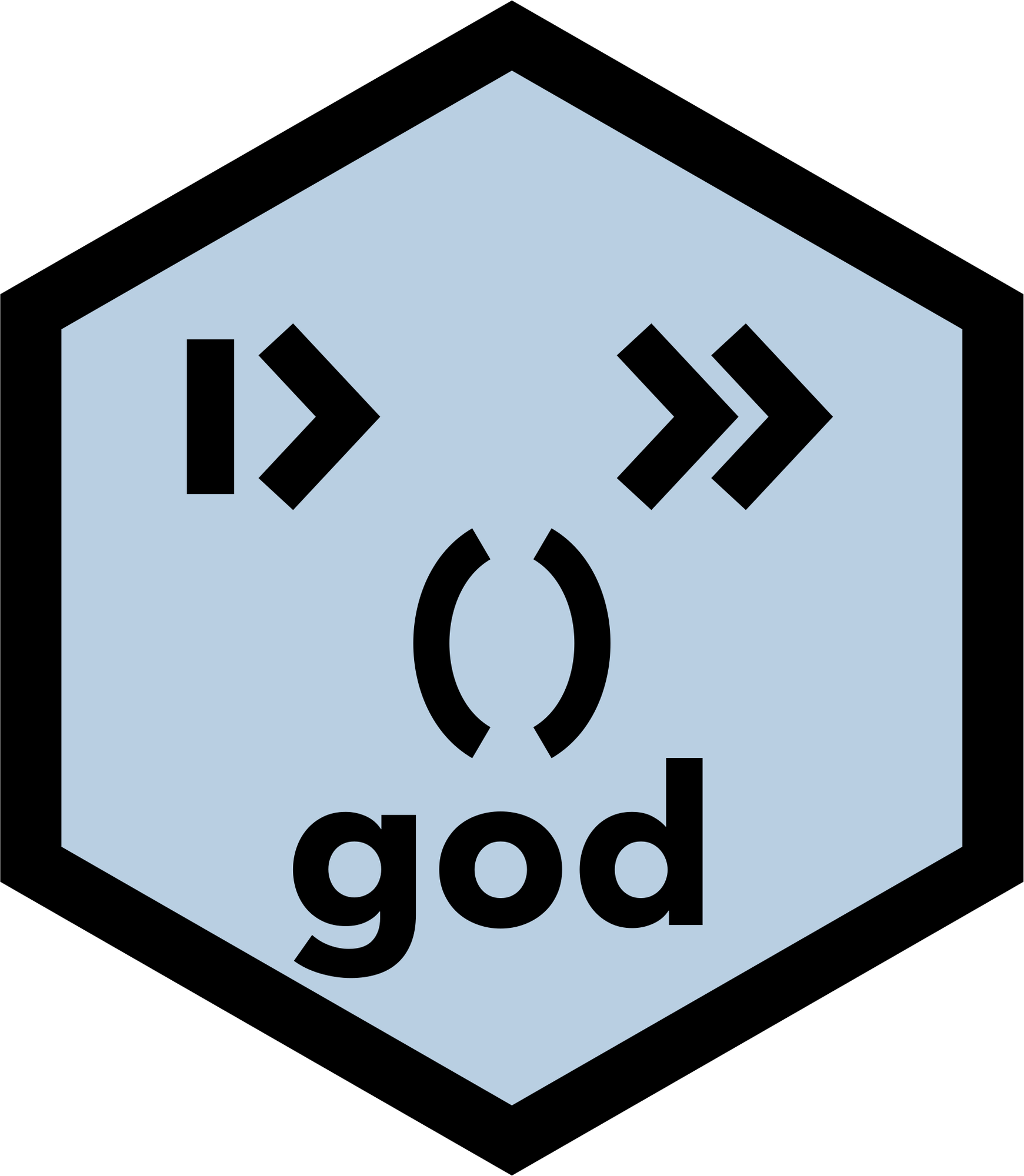
The hex sticker at the top of this page says the same thing without a sentence. R packages have carried these for years, hexagonal so that a wall of them tiles, and handing one over is how the community introduces a package. If you have come from Python, that is all it is: a logo with a shape convention.
What sits inside this one is a face. Its eyes are |> and >>, the pipe in R and the pipe in Python. Its nose is then. Its mouth is the package name.
Those marks are chosen and not decorative, and the test they had to pass is that you actually write them. A face has two eyes and this grammar has two bindings: one language on the left, one on the right, saying the same thing. Both eyes point right, so the face is looking at the next step rather than at you.
The nose is the third spelling. |> in R and >> in Python both mean and then do this to it, and the plain text form spells that same thing then. So the three marks on the face are not three ideas. They are one idea in each of the three places you can write god, which is the claim this whole book is making, sitting on the cover without a sentence.
They are also the same size as each other in practice. Across the sentences this book is tested against, |> appears 172 times, >> appears 173, and then appears 172. That is not a coincidence worth remarking on so much as a consequence: a sentence has as many thens as it has pipes, because they are the same word.
The nose was ( and ) until this was noticed, and parentheses do pass the test below. Every verb in both languages is a call, so you type them constantly. What they do not do is say the same thing as the eyes. They hold what happens inside a step, where the eyes join one step to the next, and a face whose three marks say one thing is worth more than a face whose marks are merely all frequent.
The column brackets are not on the cover, and a measurement is the reason. Across the sentences this book is tested against, [ and ] appear not once in R. The few times they appear in Python, they are Python’s own list syntax rather than anything god asks for. They are the plain text form’s way of naming a column, which is a real job, and it is not a job most readers will ever see. A cover should carry a mark its reader types.
A full stop was considered for the nose and rejected for the opposite reason. You would type it, and this book argues at some length that joining steps with a dot is the thing god was built to avoid. A cover should not say the opposite of its book.
What this grammar borrows, and from where
Its vocabulary and its working shape come from dplyr and tidyr, which solved this for R and are the reason the author still writes R. Its verbs, its grouping and its two reshaping directions are all recognizable from there, and where god differs it is usually because it had to say the same thing in two languages at once.
One further idea comes from Hangeul, the Korean alphabet designed in 1443, by way of this project’s sibling. It is one idea rather than a theme: parts that combine the same way every time are easy to read and easy to write. That is the whole of the borrowing, and nothing else about the alphabet is claimed here.
Applied, it means a small set of verbs, functions and delimiters where a rule you learn in one place holds in every other. The promise at the top of this preface is what that regularity is for. And there is a working test that keeps it honest rather than aspirational: if you can say something two ways, one of them is a bug. Report it.
Naming a column whatever you like
You can call a column sort, or total, or even then, and nothing breaks. Each spelling has its own unambiguous answer: R looks names up in your data first, Python writes col.sort, and the text form puts it in brackets.
In the text form, four delimiters each do exactly one job.
Means
[ … ]
a column, or a list of columns
" … "
a text value
( … )
a group; a name in front of one applies that name to it
{ … }
a set of values to match
Inside [ ] it is a column, always. Outside, it is grammar.
orders then sort [sort] descending
No backticks, no escape word, and no list of names you are not allowed to use. This grammar does not restrict what your columns are called; it marks where a name is being used.
The two quote marks divide the same way: double quotes belong to the grammar, for a text value, and single ones to the host, around a sentence. The chapter on what it wrote gathers the whole quoting story in one place.
Words instead of symbols, where the languages disagree
A symbol that means different things in different tools is not in this grammar. A plain word that means one thing everywhere is.
Instead of
Write
== or =
is
!= or <>
is not
TRUE / True / true
yes
FALSE / False / false
no
NA / None / NULL
missing
%in% / .isin() / IN
in { … }
& and \|
and and or
! or ~ or NOT
not
<, <=, > and >= stay as they are, because those already agree everywhere.
It will tell you what it wrote
No small vocabulary covers everything, and this one does not try. When you reach its edge, you can ask what your pipeline would be in a tool you already use:
$ god --columns 'region:text,revenue:number' --as dplyr 'sales then keep where [region] is "West" then take 10'
sales |>
  filter((region == "West")) |>
  head(10)
The pipeline is wrapped in single quotes because a text value inside it is written with double quotes, which keeps the shell out of it. The --columns list is the table the pipeline is checked against: nothing is written out until the whole sentence has passed the same checks a running one would.
Learning this grammar is meant to make the tools you already have easier, not to replace them.
When something is wrong
The whole pipeline is read and checked before any of it runs, so a mistake at step two is reported as a mistake at step two, with the word underlined:
illegal: there is no column called `reveune`. Did you mean `revenue`? The table has: region, product, revenue, cost, ordered_on
  |
2 |   then keep where [reveune] > 100
  |                    ^^^^^^^
A refusal always names what would have happened and what to write instead. And nothing is ever quietly ignored: a pipeline that runs, returns a number, and silently dropped one of your lines is the way a tool loses your trust.
What god does not do
god is not an engine. The work of joining, grouping, sorting and handling missing values is done underneath by software built for it. god owns the words, the checking and the error messages.
god also does not own your data. A table arrives from your language and leaves as one. There is no god table type to convert to, and no session to open.
Anything that does not return a table belongs to your language rather than to god. Fitting a model, running a test, drawing a plot, writing a file: those are things R and Python already do well, and a grammar that tried to absorb them would stop being small enough to read.
How fast is it?
The question has two answers, and keeping them apart is the honest way to ask it.
What god costs is compiling your pipeline: reading it, checking it against the columns, and writing the query. That is a fixed cost per pipeline rather than per row, so it does not grow with your data. A hundred rows and a hundred million rows compile in the same time.
Everything after that belongs to the engine you pointed god at. It hands DuckDB or Spark a query and does nothing else. So a comparison of god against polars is really DuckDB against polars, and reporting it as god’s number would take credit, or blame, for somebody else’s engine.
The claim this book makes is therefore narrow: the grammar costs almost nothing to put in front of an engine, and your query reaches that engine unchanged. Where the speed lives holds a measurement made to exactly that framing, in two halves that are never mixed. The grammar’s own cost is timed live while these pages are built. The engine timings beside it are a dated record, so each engine is credited with its own result. For today’s number on your own engine, ask show_as for the exact query and measure it where your data lives.
Speed was never the goal here. The goal is that you can still write a pipeline a year after the last one.
Installing it
In R, from R-universe, as a binary with nothing else to set up:
Then library(god) attaches the verbs, and every example in this book runs as printed.
In Python, from PyPI, one wheel per platform with the engine inside:
pip install grammar-of-data
The install name and the import name differ, because god was taken on PyPI in 2016 by an unrelated package: you install grammar-of-data and write import god. The examples in this book use from god import *; import god works too, with a prefix on every name.
Every example shown in both languages ran in both when this book was built, exactly as printed, and a page whose tabs disagree is a build the book refuses to ship.
Who this book is for
You have worked with data in a table before. You know what a row is, what a column is, and what it means to group by something and count. That is the whole assumption.
If you are near the start, read the book in order. The six verbs open it, one short chapter at a time, and when you finish them you can answer real questions about a table. Nothing before them is required, including this preface.
If you have used several of these tools already, you are the other reader this book is written for, and you will get more out of it from the back. Appendix C writes the same pipelines out side by side in every dialect god prints, which is the fastest way to see what is being proposed. Appendix B is the entire vocabulary on one page. How god works is where the claims in this preface are demonstrated rather than asserted, including the one about a pipeline running unchanged on a cluster.
You do not need to know dplyr, and you do not need to know pandas. If you know one of them, some chapters will read as a vocabulary list, and that is fine. If you know neither, nothing here assumes you do.
Where this stops, and what picks it up
god manipulates tables. It does not draw them, and it never will, because drawing is a different grammar with a different vocabulary.
That grammar exists, and it is this project’s sibling. gog is a grammar of graphics built on the same discipline, by the same author, with the same promise about day one and day two. The two are designed to sit next to each other. A question usually starts as a table you have to reshape and ends as a picture, so you start in god and finish in gog.
The closing chapter shows one question answered end to end that way. Read it even if you never draw a plot, because it is the clearest statement of where this grammar’s job ends.
How to read the examples
Every example that manipulates data is written twice, once in R and once in Python, and the two sit in tabs above the same explanation. Click the one you write.
Many tabsets carry a third tab, run. It holds the same sentence a third way: the grammar’s own text form, inside the one call that is spelled identically in both languages. The sentence in it is the engine’s canonical printing of the pipeline beside it, and the chunk runs like any other, so all three tabs answer with the same table.
The tabs are not illustrations of each other. Every tab is executed when the book is built, so a tab showing a table is a tab whose code ran, and the tables come back from the same engine. Suppose a sentence stopped meaning the same thing in the two languages, or the text form drifted from either. The tabs would stop agreeing on this page, which is the easiest place to notice it.
The appendix on the two languages is the exception, and deliberately so: it is about the two places the languages differ, and there the two are not the same sentence.
The state of this book
The vocabulary is closed, and every word in it is demonstrated here by a chunk that runs. That claim is checked rather than remembered: when the book builds, a script asks the engine for its word list and fails the build if any word lacks a running example. A second check hands every pipeline the book shows outside a chunk to the engine to parse.
Prose can name a verb that was never built and still render cleanly, which is why those checks exist. What no script can catch is handled the way the coverage appendix promises: dated, and corrected in public when a reader finds the mistake.
Chamberlin, D. D., & Boyce, R. F. (1974). SEQUEL: A structured english query language. Proceedings of the 1974 ACM SIGFIDET Workshop on Data Description, Access and Control, 249–264. https://doi.org/10.1145/800296.811515
Codd, E. F. (1970). A relational model of data for large shared data banks. Communications of the ACM, 13(6), 377–387. https://doi.org/10.1145/362384.362685
McKinney, W. (2010). Data structures for statistical computing in Python. Proceedings of the 9th Python in Science Conference, 56–61. https://doi.org/10.25080/Majora-92bf1922-00a
Wickham, H. (2011). The split-apply-combine strategy for data analysis. Journal of Statistical Software, 40(1), 1–29. https://doi.org/10.18637/jss.v040.i01
Wickham, H., Averick, M., Bryan, J., Chang, W., McGowan, L. D., François, R., Grolemund, G., Hayes, A., Henry, L., Hester, J., Kuhn, M., Pedersen, T. L., Miller, E., Bache, S. M., Müller, K., Ooms, J., Robinson, D., Seidel, D. P., Spinu, V., … Yutani, H. (2019). Welcome to the tidyverse. Journal of Open Source Software, 4(43), 1686. https://doi.org/10.21105/joss.01686
Wickham, H., François, R., Henry, L., Müller, K., & Vaughan, D. (2023). dplyr: A grammar of data manipulation. R package version 1.1.4. https://CRAN.R-project.org/package=dplyr