9 Architecture
One Rust core, one CLI, and thin R and Python packages that invoke it as a subprocess. No FFI.
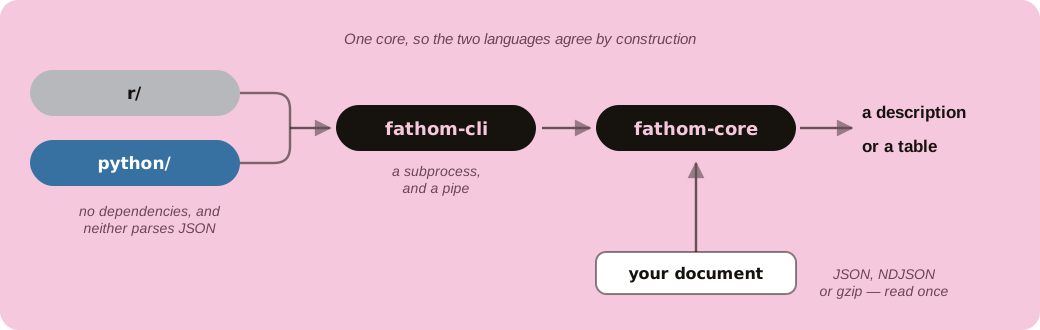
The document’s arrow is the part worth pausing on. It reaches the engine without passing through either binding, and that is a rule rather than a drawing convenience — the reason is below, and it is the same reason the parser is hand-written.
This is the sibling project’s architecture unchanged, and the obvious guess about that project is wrong: it is not bound through the usual R or Python extension toolchains. It ships a binary and calls it. So the hard part of shipping Rust to CRAN has already been solved once in this household, which is the largest single cost of the decision, and it is paid.
9.1 Why it fits
One implementation of the part that drifts. The walk, the fold, the keys-as-data classifier and the row pricing are intricate, and on the first day of this project they changed three times in two hours. Two hand-written copies would diverge, and invisible drift is exactly the danger. One core makes divergence impossible rather than merely tested-for.
No FFI toolchain, per language, forever. No ABI compatibility, no compiling on a user’s machine. A binary and a pipe.
The probe is subprocess-shaped by nature. You are not passing live objects back and forth; you are asking “describe this file” and getting a small answer.
9.2 The one place it strains
The sibling project never ships a large table across the boundary — it emits SQL and lets the database do the work, so a pipe carrying a few KB is always enough. fathom’s extract half would ship data, and a large table through stdout is where this arrangement gets uncomfortable.
So the boundary is two-shaped:
| call | crosses as |
|---|---|
| probe | a small JSON summary on stdout: health, the fold with its evidence, the priced candidates |
| extract | a columnar interchange format to a file or pipe, which both languages read natively |
The extract half is undecided until it has any design at all.
9.2.1 The payload size is a test of the thesis
The probe’s summary is a few KB whatever the document weighs — that is what “output proportional to the structure” means, expressed as an API contract.
If the core ever needed to return something proportional to the data, subprocess would be the wrong boundary and the project’s central claim would be false at the same moment. Worth watching, because it fails loudly.
9.3 Why the parser is hand-written
The core carries one runtime dependency, for gzip, because a compressed file is how JSON at scale actually ships. The JSON parser is not a dependency, and that is not preference.
A conforming parser is entitled to hide exactly the three things the health verb measures. It may reject the bare NaN that one language writes and another refuses. It may discard duplicate keys, whose silent loss is the finding. And it cannot see the sign on -0, because that survives only in the token text. A parser that hides those is a parser that hides the findings.
A fourth reason turned up during the port and none of the three predicted it: CPython’s handling of a truncated \u escape does not match its own documented guard. Parity has that story.
9.4 The representation is the point, not the speed
The measured argument for a core is not that Rust parses faster.
The prototype needs far more memory than an ordinary library in either language on the same file, and a faster parser does not fix it: three Python parsers were measured on one file and the fastest bought 11% of the memory, because all three build the same object graph and that is where the bytes are.
The win a core delivers is not parsing faster. It is never handing the host language a per-record object graph.
So the representation is a flat arena of nodes addressed by index, with every container’s children in one contiguous run and every string in one shared buffer.
The first version of it lost anyway, and by more than it should have. It measured worse than the Python prototype on the largest corpus file, because the 28 MB of text was copied three times before a single value was parsed. The arena was never the problem. That is in the findings with the date, and the lesson is the ordinary one: the thing you optimised is rarely the thing that costs.